
Abby Z and The New Utility ont présenté Radioactive Practice au théâtre Jean-Claude Carrière dans le cadre du festival Montpellier Danse 2026. Première en France.
On est sortis un peu déconcertés de Radioactive Practice… Version Française
On est sortis un peu déconcertés de Radioactive Practice… Feuille de salle en main, je lis la biographie de Abby Z and The New Utility ; c’est une ribambelle de récompenses qui présente leur travail.
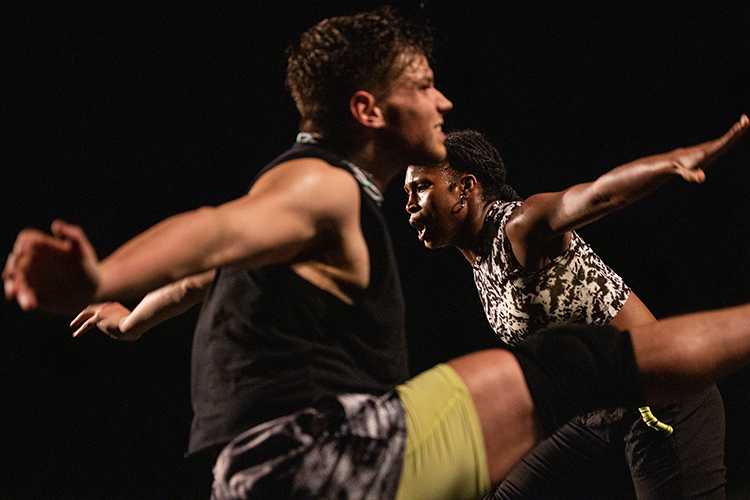
Sur le plateau du théâtre Jean-Claude Carrière, dans un quadrifrontal qui n’a pas l’air d’avoir été travaillé par un scénographe (aucun nom, d’ailleurs, n’est précisé dans la distribution), le plateau se fait salle de CrossFit sur lequel les interprètes déploient un vocabulaire emprunté aux danses africaines et afro-diasporiques. En effet, Abby Z (Z pour Zbikowski) est formée aux danses africaines et afro-diasporiques auxquelles elle retire la substantifique moelle pour la troquer contre un principe esthétique assez classique : « pousser les limites ».
La lumière met en exergue une salle aux trois quarts vide, dubitative, qui regarde les interprètes suer sang et eau comme seul gage de physicalité et d’authenticité. Quel genou peut survivre à ça ?
L’environnement sonore est produit par les corps : baskets et genouillères couinent et résonnent comme dans un gymnase, les « go » « one, two, three » ressemblent à des hurlements de coach passés à la moulinette d’un jeu vidéo 90’s : « Finish Him/Her ! »
Je suis persuadée, à l’instar de la scénographie, qu’il n’y a pas de création lumière : « try again », il y en a bien une, signée par Jon Harper. Je cherche l’humour et le second degré, « you lose » — il paraît qu’il n’y en a pas.
We left Radioactive Practice somewhat puzzled… English (US) version
We left Radioactive Practice somewhat puzzled… With the program in hand, I read the biography of Abby Z and The New Utility; their work is presented through an impressive string of awards.
On the stage of the Jean-Claude Carrière Theater, in a four-sided stage configuration that didn’t seem to bear the mark of a scenographer (no name, incidentally, is listed in the credits), the stage becomes a CrossFit gym where the performers display a vocabulary drawn from African and Afro-diasporic dance forms. Indeed, Abby Z (for Zbikowski) is trained in African and Afro-diasporic dance forms, from which she extracts their very essence, only to trade it in for a rather conventional aesthetic principle: “pushing the limits.”
The lighting reveals a house that was three-quarters empty, a skeptical audience watching the performers sweat themselves into exhaustion as the sole guarantee of physicality and authenticity. What knee could survive that?
The soundscape is produced by the bodies: sneakers and knee pads squeak and echo like in a gym; the “go” and “one, two, three” commands resemble a coach’s shouts run through the filter of a ’90s video game: “Finish Him/Her!”
I was convinced, as with the scenography, that there was no lighting design: “try again.” — there actually is one, by Jon Harper. I search for the humor, the wink, the irony — “you lose.” Apparently, there is none.
Marie Reverdy
Chorégraphie, mise en scène : Abby Zbikowski
Interprètes, collaborateurs et collaboratrices : Lucy Dillon, Kashia Kancey, Ishmael Konney, Jennifer Meckley, Benjamin Roach, Yukina Sato
Direction des répétitions : Fiona Lundie, Jennifer Meckley, Benjamin Roach
Dramaturgie : Momar Ndiaye
Création lumière : Jon Harper
Musique : Matthew Peyton Dixon
La création de Radioactive Practice a été soutenue par New York Live Arts (Live Feed Residency, New York), le National Performance Network / Visual Artist Network (NPN/VAN) et l’American Dance Festival (Durham)
Avec le soutien de plusieurs fondations et institutions américaines : Joseph and Joan Cullman Foundation for the Arts, Mertz Gilmore Foundation, National Endowment for the Arts, New York City Department of Cultural Affairs, New York State Council on the Arts, Jerome Robbins Foundation, Fan Fox & Leslie R. Samuels Foundation, Scherman Foundation, Shubert Foundation, Doris Duke Charitable Foundation, Andrew W. Mellon Foundation, ainsi que d’autres programmes de soutien à la création et aux artistes (Caroline Hearst Choreographer-In-Residence Program, Dance Umbrella Four by Four, United States Artists Fellowship, Université de l’Illinois, Wexner Center for the Arts), États-Unis.
En savoir plus sur
Abonnez-vous pour recevoir les derniers articles par e-mail.

